
• Skincare
  • Products

Sun Protection & SPF: Myths and Facts

Sun protection has become an essential part of skincare—every day of the year. At the same time, there are many myths surrounding SPF. It’s time for a fact-based reality check.

Contents

WHY USE SUN PROTECTION AT ALL?

Are you new to skincare or not yet very familiar with sunscreen? Let's start by explaining why sun protection is so important. 

From a dermatological perspective, our relationship with the sun has fundamentally changed. We often still associate UV exposure with vacations, the beach, or extreme heat, yet the majority of significant UV exposure occurs in our daily lives: while taking a walk, on the way to work, during outdoor sports, or even behind a window. The intensity of UVA radiation fluctuates throughout the year, but—unlike UVB radiation—it remains present even during the winter months and on cloudy days at a level that accelerates skin aging.

On top of that, our lifestyle has changed. We are also exposed to additional oxidative stress from environmental factors such as air pollution, with UV radiation acting as an amplifier in this regard. Sun protection is therefore less of a seasonal vacation product today and more of a daily, preventive part of modern skin care—comparable to brushing your teeth for dental health.

Also good to know: The tricky thing about UV radiation is that it takes effect even without visible warning signs. A sunburn is merely the acute, inflammatory tip of the iceberg. More relevant in the long term is what’s known as chronic light damage. UVA rays can penetrate deep into the dermis and damage collagen and elastin fibers there, leading to a loss of elasticity, wrinkles, and changes in skin structure. These processes occur gradually and go unnoticed for a long time. That’s why you shouldn’t skimp on sunscreen—and not just in the summer. But how much, when, and which products? And is that even “healthy”? We’re fact-checking and debunking a few common myths surrounding SPF. 

WHAT SHOULD YOU LOOK FOR IN A GOOD SUNSCREEN?

Effective sun protection should always be viewed as a comprehensive system, not as a single metric. The sun protection factor (SPF) primarily indicates protection against UVB radiation, which causes sunburn. However, reliable UVA protection is at least as important, since UVA rays play a major role in premature skin aging, changes in pigmentation, and structural changes in the skin. Balanced, broad-spectrum protection is therefore crucial.

Furthermore, the formulation plays a key role. Sunscreen can only be effective if it is applied in sufficient amounts and on a regular basis. Texture, how it feels on the skin, and tolerability are therefore not secondary considerations, but fundamental requirements. Modern formulations increasingly combine chemical UV filters with nourishing, antioxidant, or barrier-strengthening ingredients to not only protect the skin but also support it at the same time.

From a dermatological perspective, sunscreen is effective when it fits into a person’s daily routine and is used consistently over the long term. This is because a slightly lower sun protection factor (at least SPF 30), when applied regularly and in sufficient amounts, often provides more reliable protection in practice than a higher SPF that is used only sporadically.

<p>WORAUF SOLLTE MAN BEI EINEM GUTEN SONNENSCHUTZ ACHTEN?</p>

SPF MYTHS AND FACTS: WHAT YOU NEED TO KNOW

MYTH #1: You don't need sunscreen when you're in the shade.

Even in the shade, your skin is exposed to UV radiation. Up to 50% of UV rays reach your skin indirectly—through reflection off surfaces such as water, sand, concrete, or snow. UV radiation behaves differently from visible light and is effective even when the sky is cloudy.

MYTH #2: Makeup with SPF replaces sunscreen.

Foundation, BB cream, or powder with SPF can supplement protection, but they are no substitute for sunscreen. The amount used is usually too small to actually achieve the advertised SPF. Best practice: Apply sunscreen as a base, then apply makeup over it, and supplement with protective clothing such as a hat and sunglasses.

MYTH #3: If you reapply sunscreen, you're safe.

It is essential to apply sunscreen regularly. The duration of protection is determined by multiplying the sun protection factor by the skin’s natural protective capacity. And here’s where it gets interesting: reapplying sunscreen does not extend this duration; it merely serves to maintain the protection. 

MYTH #4: Window panes protect against UV radiation.

UVA rays can pass through window glass almost unimpeded. Daily sun protection is especially important when exposed to regular sunlight. While windshields in cars block a large portion of UV radiation, side windows allow significantly more UVA rays to pass through. Anyone who drives frequently or sits on the sunny side of the car is exposed to significant UV radiation. Sun protection is also advisable at high altitudes: UV radiation levels are higher there because the atmosphere filters out less of it. Furthermore, UVA rays reach the skin unfiltered through airplane windows, especially on longer flights or when sitting in window seats. 

MYTH #5: Sunscreen blocks vitamin D.

The myth that sunscreen completely blocks the body's production of vitamin D persists, but this blanket statement is not scientifically sound.

It is indeed true that UVB radiation in the wavelength range of approximately 290–315 nm is necessary for the synthesis of vitamin D3 in the skin. Since sunscreens with a high sun protection factor (e.g., SPF 50) absorb or reflect precisely this UVB range, they could theoretically reduce vitamin D production if applied completely, over the entire skin surface, and in sufficient quantities (2 mg/cm²) under idealized conditions. In practice, however, this effect is significantly reduced. Studies show that people usually do not apply sunscreen in sufficient quantities or cover all areas of the skin, so that some UVB radiation always reaches the skin. In addition, areas of the body such as the hands, forearms, or parts of the face often remain uncovered. A systematic review concludes that there is no reliable evidence that the normal use of sunscreen leads to a clinically significant vitamin D deficiency, especially not under everyday conditions with regular sun exposure. Sunscreen effectively protects against UV-induced skin damage without generally leading to a vitamin D deficiency.

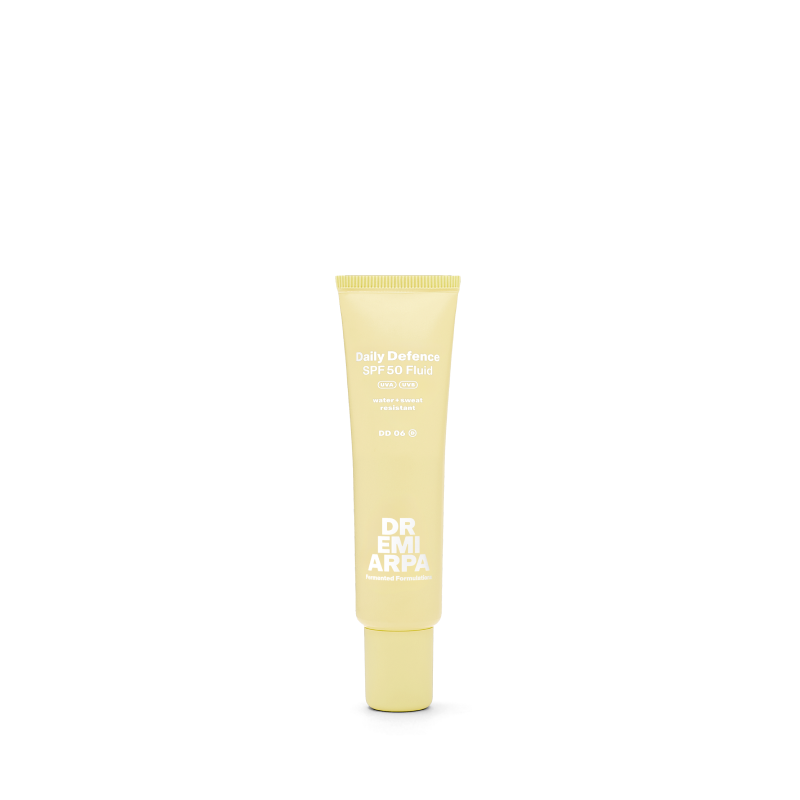
PRODUCT SPOTLIGHT: DAILY DEFENCE SPF 50 FLUID

Your daily protection is back and better than ever. This lightweight sunscreen with an optimized formula offers high sun protection (SPF 50) and skin care with a silky, sheer finish. The postbiotic it contains strengthens the skin barrier, ectoine hydrates the skin, and vitamin E reduces oxidative damage. 

Suitable for all skin types, water- and sweat-resistant, dermatologically tested for skin compatibility: Your daily sun protection for your face. Your daily defense!

Daily Defense SPF 50 Fluid

  • SPF 50 provides high UV protection.
  • Postbiotics strengthen the skin's natural protective function.
  • Ectoine has a moisturizing effect .
  • Vitamin E has antioxidant properties.

Your daily defense!

KEY TAKEAWAYS

Sun protection is a daily, preventive part of modern skincare every day of the year, because the majority of UV exposure occurs in everyday life—even in the shade, behind window panes, or on an airplane. A fact-based reality check debunks the most dangerous SPF myths: makeup with SPF is no substitute for sunscreen, reapplying makeup does not extend the duration of a single application’s protection, and normal use does not lead to a clinically significant vitamin D deficiency under everyday conditions. Good sun protection requires not only protection against UVB radiation but also reliable UVA protection for balanced broad-spectrum protection. The Daily Defense SPF 50 Sun Fluid offers high UV protection with a lightweight texture, strengthens the skin barrier with a postbiotic, moisturizes with ectoine, and provides antioxidant benefits thanks to vitamin E.

BASF Personal Care. (n.d.). The Skin's Natural Protection. Retrieved June 10, 2025, from https://www.personal-care.basf.com/core-competencies/alles-%C3%BCber-sonne/haut-hauttypen/der-eigenschutz-der-haut

BASF Personal Care. (n.d.). What Exactly Are SPF, LSF, and Others? Retrieved June 10, 2025, from https://www.personal-care.basf.com/core-competencies/alles-%C3%BCber-sonne/sonnenschutz/was-genau-ist-dieses-spf-lsf-co

Federal Office for Radiation Protection (BfS). (2025). UV Protection with Sunscreen. Retrieved May 19, 2025, from https://www.bfs.de/EN/topics/opt/uv/protection/sunscreen/sunscreen_node.html

Federal Office for Radiation Protection (BfS). (n.d.). Disinfection with UV-C Radiation. Retrieved June 4, 2025, from https://www.bfs.de/DE/themen/opt/anwendung-alltag-technik/uv/uv-c-strahlung/uv-c-desinfektion_node.html 

Federal Office for Consumer Protection and Food Safety (BVL). (n.d.). Sunscreen Products—Requirements and Labeling. Retrieved June 4, 2025, from https://www.bvl.bund.de/DE/Arbeitsbereiche/03_Verbraucherprodukte/02_Verbraucher/03_Kosmetik/06_Sonnenschutzmittel/bgs_kosmetik_sonnenschutzmittel_node.html

Busch, L., Kröger, M., Zamudio Díaz, D. F., Schleusener, J., Lohan, S. B., Ma, J., Witzel, C., Keck, C. M., & Meinke, M. C. (2023). Far-UVC- and UVB-induced DNA damage depending on skin type. Experimental Dermatology, 32(9), 1582–1587. 

Callewaert, C., Ravard Helffer, K., & Lebaron, P. (2020). The skin microbiome and its interaction with the environment. American Journal of Clinical Dermatology, 21(Suppl. 1), 4–11.

Fajuyigbe, D., & Verschoore, M. (2021). Sun exposure and Black skin. In Current Problems in Dermatology (Vol. 55, pp. 62–71).

Fitzpatrick, T. B. (1988). The validity and practicality of sun-reactive skin types I through VI. Archives of Dermatology, 124(6), 869–871.

Gupta, V., & Sharma, V. K. (2019). Skin typing: Fitzpatrick grading and others. Clinics in Dermatology, 37(5), 430–436.

Lim, S. S., Mohammad, T. F., Kohli, I., Hamzavi, I., & Rodrigues, M. (2023). Optimization of skin phototype classification. Pigment Cell & Melanoma Research, 36(6), 468–471. 

Neale, R. E., Khan, S. R., Lucas, R. M., Waterhouse, M., Whiteman, D. C., & Olsen, C. M. (2019). The effect of sunscreen on vitamin D: A review. British Journal of Dermatology, 181(5), 907–915. 

FAQ

Sunscreen protects the skin by containing UV filters that absorb and, in some cases, partially reflect harmful UV radiation. This prevents the majority of UVB and UVA rays from penetrating the skin and causing damage such as sunburn, premature skin aging, or cellular changes like skin cancer.

The duration of protection depends on your skin type. As a rule of thumb: natural protection time × sun protection factor. With a natural protection time of 10 minutes and a sun protection factor of 50, that would theoretically be 500 minutes. In reality, however, the protective effect is reduced—for example, due to applying too little product, sweating, water, or friction. Therefore, reapplying sunscreen regularly is crucial.

The effectiveness of sunscreen wears off after about two to three hours—regardless of the SPF. Water, sweat, or friction can also cause the protection to wear off more quickly. Therefore, reapply every two hours and after swimming or drying off.

Applying it just once isn't enough. For optimal protection, apply sunscreen generously 15–30 minutes before going out in the sun, and reapply every two hours and after contact with water or a towel.

Yes—when applied correctly, sunscreen can effectively protect against sunburn, especially if it protects against both UVB and UVA rays. It’s important to use the right amount and reapply it regularly.

Sunscreens approved in the EU undergo rigorous safety assessments. There is no reliable evidence that sunscreen, when used correctly, is carcinogenic. On the contrary: Sunscreen is safe and helps reduce the risk of UV-related skin cancer. UV radiation, on the other hand, is considered carcinogenic.

Short answer: No, unfortunately not. Unfortunately, the math works differently when it comes to SPF. If you apply makeup with SPF 15 over your Daily Defence SPF 50 Fluid, you won’t end up with SPF 65, but rather, at most, the protection provided by the strongest product (i.e., SPF 50)—and even then, only if you’ve used enough of it and applied it correctly.